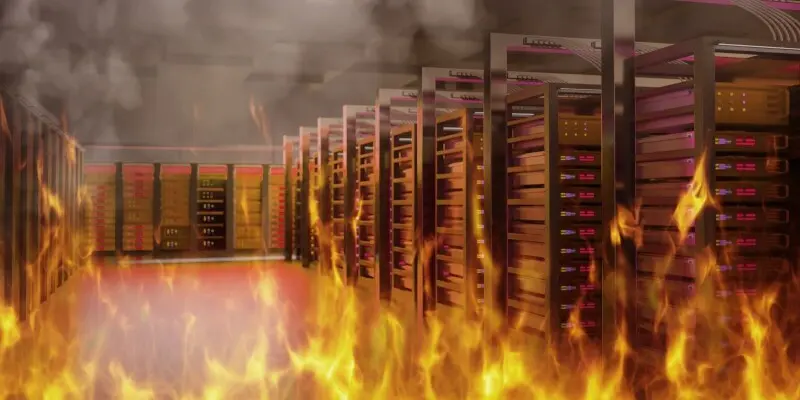
The widespread service disruptions observed over the past week suggest a more fundamental issue than a coordinated malicious attack, pointing instead toward significant technical debt within current systems.
The notion of rogue artificial intelligence or state-sponsored hacking appearing as the root cause of the recent service instability might be preferable to the reality revealed by the recent spate of system wobbles.
In a week marked by significant industry news, the most prominent theme has been the experience of outages affecting entities ranging from Microsoft to the NSA. The concerning aspect, however, is that the underlying cause does not appear to be artificial intelligence or hostile nation-state actions targeting critical infrastructure.
The revelations from this week's downtime indicate, as previously discussed on The Kettle less than a month ago, that much of our vital technological infrastructure is maintained precariously.
Host Brandon Vigliarolo, alongside cybersecurity editor Jessica Lyons and open source reporter Liam Proven, will discuss the implications of these events and whether remediation is possible without a complete overhaul of existing systems. A lightly edited transcript is available below.
Brandon Vigliarolo, the Register reporter, opened the discussion by noting that if listeners are hearing this, it implies a current absence of service interruptions, which seems like a high bar given the past week. This period was busy, including Anthropic's IPO and ongoing Nvidia developments, but the dominant conversation centers on what has become known as "Outagepalooza," as numerous services experienced downtime recently.
Jessica Lyons and Liam Proven are present to discuss this chaos and the accompanying conspiracy theories. Brandon asked what was transpiring. Jessica Lyons stated she was prepared, having her "tinfoil hat on." Brandon echoed this, mentioning family inquiries about an impending global crisis, questioning if AI was responsible.
Liam Proven shared a personal anecdote about his mother's wardrobe door getting stuck, leading him to contact a company found via a local listing in the Irish Sea. This individual, who uses Hotmail and is affiliated with Microsoft, failed to respond to his emails. When contact was finally established via SMS, the repair person expressed frustration over the lack of response, stating, "No, I've got no email, I've got no internet, I've got nothing."
Brandon acknowledged the week had been eventful, prompting Jessica to update the audience on the failures of the preceding days. Jessica began with Microsoft, noting the issue was broader than just Outlook. Similar to Liam's experience, her father reported being unable to access Outlook during dinner with friends, prompting questions about a potential cyber attack or DDoS attempt against Microsoft. However, Microsoft later clarified that the issue stemmed from a faulty software update deployed in July, impacting all 365 services as of last Thursday.
The day following this, the FAA suspended all air travel. Jessica noted that, following the Microsoft issues, people were still experiencing problems with Microsoft services when the grounding occurred. Initially, the cause was believed to be a communication error, a scenario often associated with state-level attacks. The true reason, however, was identified as a network upgrade by their provider, L3Harris, which involved replacing copper wiring with fiber, an ongoing project that seemed ill-timed for Friday the 13th.
Moving on, on Monday, major American financial institutions, including Chase and US Bank, experienced an inability for customers to withdraw funds, which was also attributed to a substantial outage. Chase later attributed this to a software bug within an on-premises hardware system, denying any cyber attack involvement. The following day, the internal communications network of the US National Security Agency went offline. Since this involves highly classified internal discussions, the immediate public assumption was an attack. The agency subsequently reported this was due to scheduled routine maintenance.
Furthermore, Apple encountered issues on Tuesday, affecting several services such as Apple Support, iCloud, Apple Pay, and their physical retail locations. This meant individuals seeking assistance were unable to receive it because Apple's systems were down. This sequence of failures across major corporations and government bodies led the public to automatically assume a large-scale, coordinated cyber assault, which was not the case in most instances.
Liam noted that Canonical also suffered an outage. While the FAA incident was less visible in Europe, Canonical was targeted by a distributed denial of service attack just before its semi-annual Ubuntu Summit. Although some services remained functional, this timing was unfortunate.
Brandon confirmed that the Canonical event was indeed attributable to an attack. Liam elaborated that this appeared to be another DDoS event, but he pointed out that it is not uncommon for highly visible open-source projects to originate from small entities. He added that while Canonical is not a massive corporation and operates remotely, making it relatively easy to take offline, it complicates determining whether incidents are attacks or simply general vulnerabilities.
Liam explained that it is becoming difficult to differentiate between actual attacks and systemic weaknesses. He cited the example of bots attempting to crawl various websites, which effectively constitutes a DDoS load against PHP-based infrastructure, even if it isn't a "true" DDoS. Brandon concurred that such volume-based issues can become unintentional. Liam further remarked that the distinction between a denial of service attack and simply being under extreme load is becoming somewhat irrelevant, drawing a parallel to the universal experience of bank phone lines being overwhelmed.
Brandon then questioned whether there was a single factor to blame, suggesting the immediate leap to blaming AI or cover-ups. Jessica offered an alternative framework, suggesting the root cause lies within the broader context of deferred maintenance due to aging, underfunded infrastructure. She noted that older software bugs are now surfacing because AI has become proficient at discovering them in both commercial and open-source code that lacked security as a primary design consideration. This convergence of factors necessitates a massive infrastructure upgrade and rapid patching to prevent attackers from reverse-engineering vulnerabilities with AI and exploiting them, creating a situation that mimics an attack but stems from software decay.
Brandon returned to the speculative angle, suggesting the possibility that entities might be concealing the fact that OpenAI agents are causing network crashes through poorly coded exercises escaping sandboxes. Liam suggested rephrasing this line of inquiry.
Why it matters
These widespread disruptions suggest systemic vulnerabilities across essential infrastructure, rather than a coordinated attack. The underlying issue appears to be significant technical debt within critical platforms. Readers should watch for further analysis on the resilience of core operational technology.