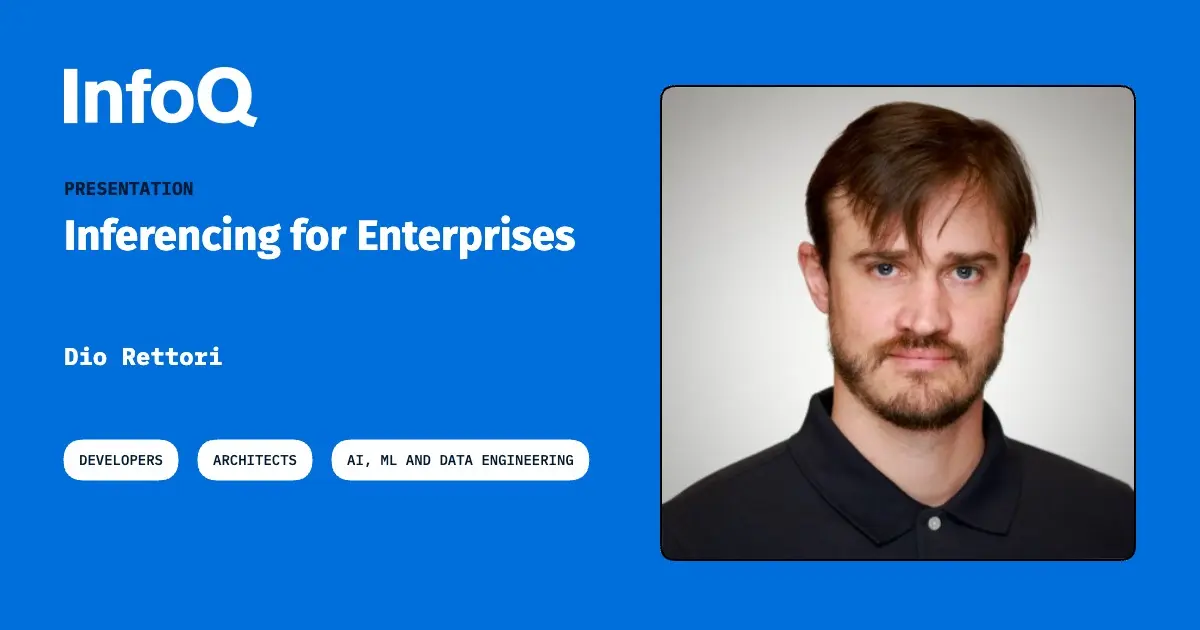
Rettori, who serves as Product Lead for Global AI Infrastructure Platforms at JPMorganChase, brings over 25 years of professional experience to this discussion. His background includes leading cloud transformations for Asset & Wealth Management and overseeing the firm's multi-cloud strategy. Previously, he held roles in product and marketing within cloud-native solution providers such as Red Hat, Pivotal, and Solo.io.
The presentation focuses on the practical operational realities of deploying AI inference within large organizations. It examines GPU utilization challenges, contrasts the total cost of ownership (TCO) between on-premises and cloud deployments, and analyzes the predictability of latency in multi-agent systems. Furthermore, he asserts that organizations must integrate domain ontology directly into models, rather than relying exclusively on Retrieval-Augmented Generation (RAG).
QCon AI serves as an event geared toward engineering practitioners, offering direct insight into the architectural blueprints and performance metrics utilized by peer organizations in live production environments.
Rettori remarked, "I'm super excited to be in an AI conference, because the best thing about being in an AI conference is that we pretty much don't need to do any work anymore. Because AI is doing all the work for us." He also noted that speaking engagements have become relatively simple in the current climate, stating, "Even as a speaker, it's a pretty easy life to just speak in today's world, because AI can do the entirety of your presentation for you. I actually didn't do anything."
The discussion will cover six distinct themes, which Rettori describes as each being a complex area unto itself, aiming to educate attendees on critical aspects of enterprise AI inference.
From the perspective of a large institution like JPMorgan, the focus shifts from solving minute technical optimizations, such as gaining an extra half token per second in a call, to understanding the broader implications for the enterprise. Rettori emphasized that much of the content presented reflects industry observations, and attendees should not view every statement as an official stance of JPMorgan Chase, as personal viewpoints may diverge from the firm's official positions.
He began by establishing a fundamental differentiation between training and inference workloads. Training is comparable to a massive High-Performance Computing (HPC) job, where factors such as the distributed framework, experiment management, and priority queues are paramount—the latter being crucial given finite training capacity. In training, operations often revolve around metrics like epoch time, loss curve reduction, cost per run, and quality assurance.
In contrast, inference is characterized as a stateful, bursty, and real-time, user-facing workload, making latency a primary concern. The core challenge here involves maintaining response speed stability against finite serving capacity. Key metrics to monitor include time for the first token and token throughput, alongside implementing latency-aware routing and session affinity.
Both training and inference share a common optimization goal: maximizing the utilization of available resources. The most costly asset in both scenarios is generally the GPU, and inefficient utilization represents a significant financial waste.
The operational requirements for inference specifically include memory-optimized accelerators (GPUs), KV cache-aware serving, security, governance, isolation, and prompt output safety controls, alongside garbage retrieval. This contrasts with the training focus on core stack and distributed frameworks.
The industry is currently trending toward specialization, moving away from using the same GPU clusters for both training and inference. NVIDIA recently announced a partnership with Grok involving an inference-focused chipset. Furthermore, Cerebras is noted for its work on very large silicon dies, aiming to integrate substantial memory onto a single processor to achieve faster inference speeds. Rettori cautioned that solutions are rarely binary, asserting that "It's never one versus the other solution; it's always a combination of things."
An internal view of an inference call reveals a division of labor between the CPU and GPU. While the tokenization process, which is part of the input handling, occurs on the CPU, the subsequent processing involves both CPU and GPU components. The process starts with an input, which is tokenized, and then the system proceeds through embeddings, involving both processing units.
The broader trend suggests that as AI capabilities advance, the focus for large technology operators is shifting from merely achieving functional outputs to managing the complex, resource-intensive infrastructure required to sustain reliable, high-throughput, and governed real-time operations.
Why it matters
For infrastructure and platform operators, this signals that enterprise AI inference is a complex engineering challenge, not just a token generation speed issue. Understanding the TCO and system design choices is crucial for building scalable, compliant AI platforms.