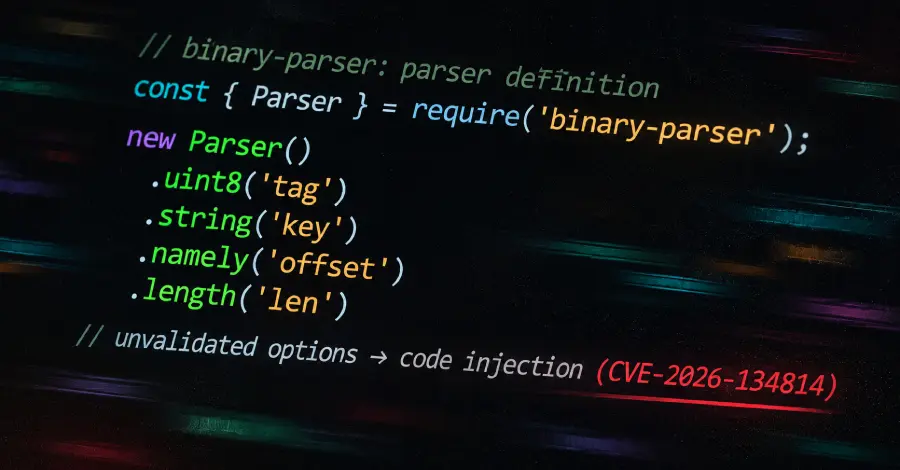
Code injection is possible through a critical security defect discovered within the widely used binary-parser library, granting an attacker who has control over parser definitions the ability to run unauthorized code. This vulnerability, cataloged as CVE-2026-134814, carries a CVSS score of 9.2 / 8.1 and affects versions of binary-parser preceding 2.3.1. Specifically, the library's earlier iterations harbor a code injection flaw, as noted in the description: "Binary-parser before 2.3.1 contains a code injection vulnerability that allows".
This exposure in a core parsing component presents a significant risk to platform integrity, as control over parser definitions directly translates to potential remote code execution capabilities.
The disclosure highlights ongoing challenges in maintaining security posture across widely adopted infrastructure components, where flaws in parsing mechanisms can introduce severe operational risks for market participants and institutions alike.
Why it matters
This high-severity flaw presents a significant risk to any platform relying on this binary-parser library. Operators must immediately upgrade to version 2.3.1 or later to mitigate the potential for remote code execution.