Meta's Privacy Aware Infrastructure (PAI) features PrivacyLib, a common library designed to enforce privacy requirements as data traverses Meta's varied data and processing systems.
Previously, implementing a new privacy mandate necessitated coding the same enforcement logic separately within each system. PrivacyLib addresses this by providing a shared library that executes inside the clients of Meta's data and processing systems.
This architecture allows a system to integrate with PrivacyLib only once; subsequent privacy capabilities are added as modules that reuse that initial integration. PrivacyLib executes billions of checks every second, with changes being simulated and rolled out on a per-module basis.
For internal AI agents, whose data access paths may not be known beforehand, tool calls on supported routes pass agent context to PrivacyLib. This propagated context links each access to its session, enabling modules to monitor data usage and block unauthorized operations.
At Meta, the core privacy question often boils down to verifying that data only travels to authorized locations. To answer this without relying solely on manual audits that can fall out of sync with system changes, Meta developed PAI to handle this within the infrastructure itself.
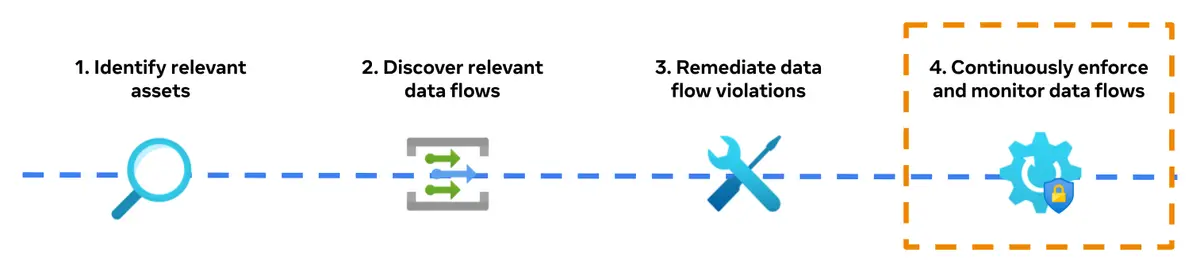
PrivacyLib is central to the final phase of the PAI workflow: continuously monitoring and enforcing data flows. Before its implementation, integrating privacy enforcement meant separate coding in each system's client, which could take months for a new requirement.
PrivacyLib decouples system integration from requirement implementation. Systems integrate once, and when a requirement can be met at the access point, it is implemented as a shared PrivacyLib module. This means a new requirement does not demand a distinct implementation across every system.
Modules fall into two categories: enforcing modules, such as Policy Zones which enforces purpose limitation by blocking access, and observing modules, like Privacy Probes, which merely record data access signals. The Agent Observability module was also added to monitor data access events related to internal AI agents.
Operating at Meta's scale presents significant engineering challenges, including coverage across diverse access paths, managing billions of checks per second, and ensuring reliability since privacy logic runs in critical, independently released service hot paths.
The system handles various access methods, including typed client libraries where PrivacyLib has full request context, and lower network boundaries for remaining RPC paths to achieve comprehensive coverage.
In a walkthrough concerning messaging metadata, when backend services use Logger to write metadata to data warehouse tables, the PrivacyLib integration within Logger invokes Policy Zones. This module checks if the metadata can flow to the target table, based on inputs and runtime evaluation.
For data structures, Logger's configuration is translated by its code-generation pipeline into a PrivacyLib-compatible artifact. This artifact carries the destination identity and the necessary messaging annotation, ensuring consistency across all writers to that destination table.
This design allows the enforcement decision to be returned to Logger after PrivacyLib combines the request context with the generated destination metadata, thereby protecting messaging metadata as it is processed.
This development reflects a broader trend among sophisticated technology operators to move complex governance and compliance logic from application-specific code into reusable, infrastructure-level primitives. This allows for rapid evolution of product features while maintaining rigorous control over data movement.