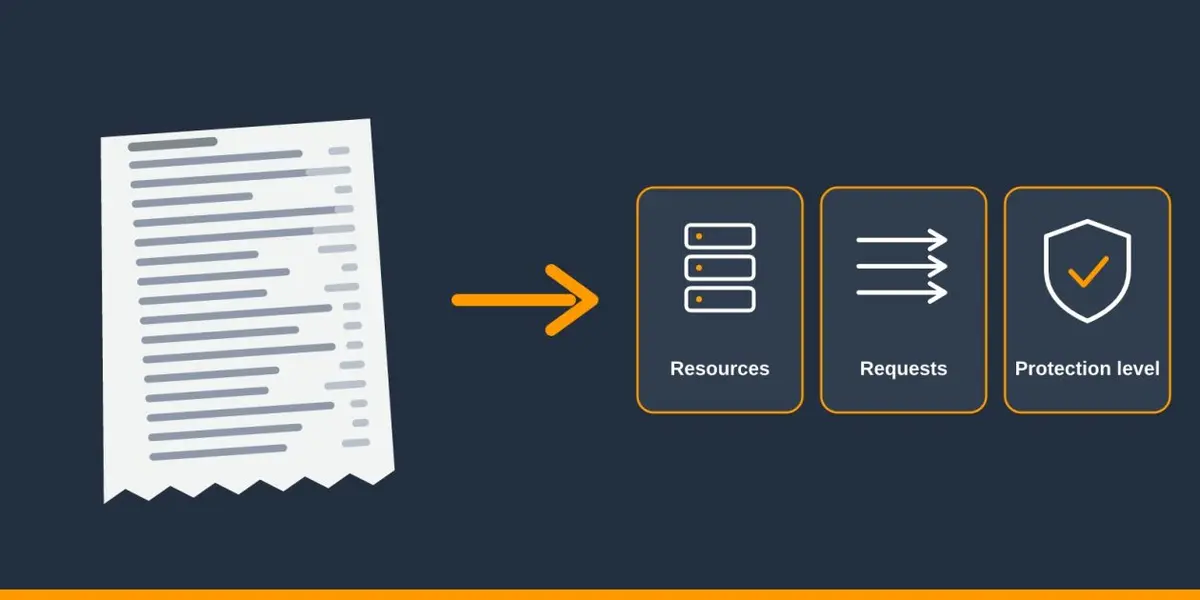
Billing is determined by three quantifiable factors: the infrastructure elements under defense, the volume of traffic examined by AWS WAF, and the sophistication of the defenses applied to that traffic. Operators currently utilizing AWS WAF will transition to this revised structure on February 1, 2027; prior to that date, existing arrangements remain in effect without any required action from the user. This document outlines the modifications, provides methods for cost projection under the new framework, and directs users to the AWS WAF pricing page for comprehensive details and illustrative examples. For nascent or smaller deployments, the Free plan associated with CloudFront flat-rate pricing presents an alternative entry point. Specifically, if an application handles fewer than one million requests monthly, the Free plan incurs no charge per month for every CloudFront distribution, encompassing AWS WAF protection against typical web threats, DDoS defense, and the CloudFront CDN, all without charges for exceeding limits.
The rationale behind this pricing revision stems from the previous model, where implementing an extra layer of protection often necessitated an additional charge, thereby intertwining every security determination with a financial commitment. The revised structure successfully segregates these two considerations, allowing stakeholders to clearly visualize the trade-off between security posture and expenditure. Activating a specific rule, employing the Bot Control common protection, or enabling the Anti-DDoS rule group will no longer introduce a subscription fee or a separate charge per request; these requests are instead billed under the standard base request rate. Furthermore, capacity constraints no longer influence the rate structure. Each protection package (web ACL) now incorporates up to 2,500 web ACL capacity units (WCUs), an increase from the former 1,500, and exceeding this included capacity will not elevate the per-request cost. The premium request fee is reserved exclusively for traffic routed through enhanced protective measures. Cost estimations can be generated before defining any rule, and these projections remain valid even as rules undergo modifications. Security rule configurations are subject to frequent revision; a newly discovered CVE or a shift in bot behavior might necessitate an update on the same day. Altering, reordering, or deleting rules will not impact the established rate.
For current AWS WAF users, their accounts will maintain the existing pricing scheme until February 1, 2027. If an organization holds an AWS WAF private pricing agreement, that agreement remains valid until its expiration date. Users are not required to calculate these financial impacts independently. The AWS WAF pricing page features worked-out scenarios demonstrating how the three associated fees aggregate for common operational loads. Should any inquiries arise regarding the application of the new pricing to a specific account, contacting the AWS account team or initiating a Support case is advised. There are no changes for subscribers of AWS Shield Advanced; their Shield Advanced subscription, its associated cost, and the included AWS WAF entitlement will remain unchanged. AWS WAF will continue to be included up to 1,500 WCU per protection pack (web ACL), the resources covered by Shield Advanced will remain unmetered, and the base requests for AWS WAF will stay free up to 50 billion per calendar month. Customers operating under a CloudFront flat-rate pricing plan will also observe no alterations; AWS WAF remains integrated within their plan, and the plan’s included request volume stays constant.
The operational billing for AWS WAF comprises three distinct charges. The resource fee is an hourly charge levied for every resource linked to a protection package (web ACL), covering assets AWS WAF can safeguard, such as Amazon CloudFront distributions, Application Load Balancers, and Amazon API Gateway APIs. The base request fee is applied to every request that AWS WAF performs an inspection on. The premium request fee is applied atop the base request fee, specifically to those requests that advanced protections evaluate, including Bot Control targeted protections, Fraud Control, API Security, and AI Security. AWS WAF is also rolling out two novel managed rule groups today: API Security and AI Security; both utilize the same premium request fee, without requiring a separate subscription or rate. The current roster of advanced protections can be found in the AWS WAF Developer Guide. The fee structure details are as follows: For the Resource fee, it is charged per resource associated with a protection pack (web ACL), prorated hourly at a rate of $0.01 per hour (approximately $7.30 per month). The Base request fee amounts to $0.60 per million requests that AWS WAF inspects. The Premium request fee is $5.00 per million requests evaluated by advanced protections, in addition to the base request fee. Requests scrutinized by one or more advanced protections are billed at $5.60 per million, which combines the $0.60 base request fee and the $5.00 premium request fee. AWS WAF applies the premium request fee only once per request, irrespective of how many advanced protections evaluate it; for instance, a request evaluated by Bot Control targeted protections, API Security, and AI Security is still billed at $5.60 per million. A request that an earlier rule blocks before reaching an advanced protection is billed only the base request fee; for example, a request stopped by a custom rule prior to reaching Bot Control is billed $0.60 per million, not $5.60. Figure 1 illustrates the mapping of each prior AWS WAF charge component under the new three-dimension model. Furthermore, AWS WAF inspects request bodies up to the maximum size supported by each linked resource type, without incurring extra charges. Refer to Considerations for managing body inspection in AWS WAF for current limits per resource type.
The updated pricing scheme also incorporates the Security analytics dashboard. This dashboard provides comprehensive traffic metrics for the protected applications across a rolling 21-day span. It allows users to observe the requests their protection packs (web ACLs) are examining and how their rules are responding, which aids in fine-tuning protections and understanding the drivers of request fees. This dashboard is provided at no additional cost. To gauge your potential expenditure, Figure 2 demonstrates how the three dimensions combine for three distinct workload scenarios. Example 1 involves a single protected resource, an Application Load Balancer processing 20 million requests monthly; the Resource fee is calculated as 1 resource $\times$ $0.01 per hour $\times$ 730 hours equaling $7.30; the Base request fee is 20 million $\times$ $0.60 per million equaling $12.00; resulting in a total of $19.30 monthly. Example 2 represents a larger operational scope, involving 40 resources handling 150 million requests monthly; the Resource fee is $292.00 (40 $\times$ $7.30$), and the Base request fee is $90.00 (150 million $\times$ $0.60 per million$), leading to a combined total of $382.00 monthly, where the resource fee constitutes the greater portion. Example 3 focuses on advanced defenses, with 5 resources managing 300 million requests, of which 30 million are assessed by advanced protections; the Resource fee is $36.50 (5 $\times$ $7.30$), the Base request fee is $180.00 (300 million $\times$ $0.60 per million$), and the Premium request fee is $150.00 (30 million $\times$ $5.00 per million$), yielding a final total of $366.50 monthly.
To estimate one's own costs, the initial step should involve determining the number of resources connected to each protection pack (web ACL), as this dictates the resource fee. For request volumes, AWS WAF publishes Amazon CloudWatch metrics for every protection pack (web ACL) and each protected resource, including data on requests evaluated by advanced protections. The Security analytics dashboard offers this same traffic perspective without necessitating custom report generation. Certain architectural decisions can also optimize costs; deploying protection at Amazon CloudFront can be less expensive than defending numerous downstream resources individually. If an organization serves multiple customer domains, Amazon CloudFront SaaS Manager permits managing them as tenants within a single multi-tenant distribution, allowing for the application of one protection pack across all of them. Scope-down statements direct advanced protections only to traffic that warrants their scrutiny, such as traffic directed toward login or checkout workflows.
The new AWS WAF pricing is effective immediately. To begin, users should access the AWS WAF console, examine their protection packs (web ACLs) and their associated resource bindings, and consult the examples provided on the AWS WAF pricing page. Regarding frequently asked questions, AWS WAF does charge for requests it blocks; it bills every request it inspects, inclusive of blocked ones. The protected resource bills these requests as normal, with the exception of Amazon CloudFront, which does not charge for requests AWS WAF blocks (further details are available). If a request traverses two protection packs (web ACLs), it is billed by both; for example, if a request passes through a protection pack on a CloudFront distribution and another on the Application Load Balancer situated behind it, each protection pack (web ACL) will bill for it. The Security analytics dashboard incurs no extra charge. Pricing for AWS Marketplace managed rule groups and AWS Shield Advanced remains unchanged, and resources protected by Shield Advanced retain their existing pricing. There is no standalone free tier for AWS WAF; however, if an application is served via CloudFront and processes fewer than 1 million requests per month, the CloudFront flat-rate Free plan includes AWS WAF at $0 per month. For specific plan details, users should consult the CloudFront flat-rate pricing plans. If an application requires more than 2,500 WCU