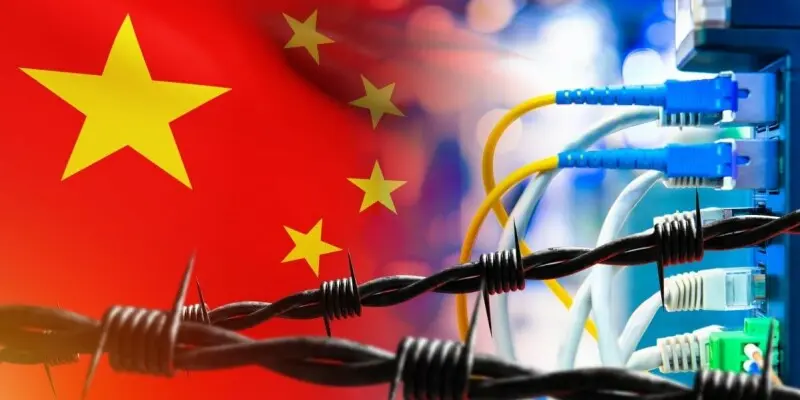
The discovery of novel methods to bypass China’s Great Firewall was achieved using only $1 worth of tokens, according to research presented last week at the Conference on Computer and Communications Security, which is organized by the Association for Computing Machinery’s Special Interest Group on Security, Audit and Control. This finding, detailed in a paper titled “CircumVolve: Automated Discovery of Censorship Evasion Strategies Using Large Language Models,” was authored by six individuals affiliated with the University of Massachusetts Amherst, the University of Colorado Boulder, and the activist organization Great Firewall Report. The authors assert that identifying weaknesses within the Great Firewall is an extremely demanding undertaking, making it a suitable task for artificial intelligence.
The researchers developed a utility they named “CircumVolve,” which they characterize as “a system for automated discovery of censorship circumvention strategies across the full network stack.” The authors explained that “CircumVolve combines LLM code generation with iterative feedback-driven evaluation to produce verifiable and deployable evasion techniques.” Furthermore, “CircumVolve models different censorship techniques as discrete scenarios, each capturing the specific context, protocol constraints, and blocking mechanisms of real-world censors.” Within each of these scenarios, evasion tactics are represented as executable Python programs that implement modifications to packets and protocols. These manipulations range from rewriting TCP/IP header fields to designing DNS queries that exploit parser ambiguities, and even altering the internal structure of encrypted QUIC Initial packets, all while either maintaining protocol correctness within acceptable limits or strategically breaking it when advantageous.
Testing of CircumVolve involved simulated censorship apparatus employed by China, Iran, Pakistan, and Kazakhstan, as well as virtual private servers hosted on cloud infrastructure within those nations. These trials revealed that the median cost to achieve the initial successful evasion was less than $1 in token expenditure when utilizing GPT-5.1. The authors conceded that operators managing censorship infrastructure might be able to detect CircumVolve's operations, but they believe that its relatively small data payloads—80 KB outgoing and 150 KB incoming—along with the 25-45-second intervals between tests, could allow it to remain undetected. The researchers concluded, “CircumVolve represents a first step in leveraging LLMs to accelerate the censorship-circumvention lifecycle.” They further noted that “By automating the labor-intensive tasks of protocol analysis, implementation, and testing, AI-driven approaches make studying circumvention capabilities far more accessible to the comparatively under-resourced Internet freedom community [and] demonstrates how AI-assisted systems can narrow the resource gap between Internet freedom advocates and well-funded censoring states.”
In a separate business development note, the hardware giant Lenovo has finally achieved substantial profitability in its datacenter operations. Since acquiring IBM’s x86 server business back in 2014, Lenovo has faced difficulties in generating profits from its datacenter sales, despite expanding its involvement into storage, networking, and supplying hyperscalers. The current surge in AI has finally enabled the company’s Infrastructure Solutions Group (ISG) to reach a quarterly profit of $1 billion, an achievement that previous strategic adjustments and market enthusiasm failed to secure.
The company reported in its Q2 results announcement [PDF] last week that ISG revenue reached a quarterly high of $11.3 billion, marking a 178 percent increase year-over-year, alongside the substantial profit mentioned. Lenovo stated that it managed to boost shipments of x86 servers and even secured the position as the largest vendor of these systems, holding a 16 percent market share, even amid tight enterprise hardware supply chains. Moreover, the company claimed further advancement as the world’s leading PC provider, citing a 15 percent year-on-year growth for its intelligent devices group, which generated $17.4 billion in quarterly revenue. Lenovo indicated it commands 23.8 percent of the PC market and now possesses seven percent greater market share than its closest competitor, Apple. The firm also noted that premium devices constitute 63 percent of its PC business. Overall, quarterly revenue climbed 48 percent year-over-year to $30.24 billion.
The global trend toward automated discovery, as seen with LLMs targeting censorship, mirrors broader shifts in how technology is being leveraged across infrastructure and security domains.
In unrelated corporate news, the Chinese hardware giant Lenovo finally attained massive profits from its datacenter operations.
In a separate development, the Commonwealth Bank (CBA) in Australia introduced an AI-powered tool, named “CodeCheck,” designed to scan its proprietary code for defects, which it has released freely. The bank stated that this tool employs “a consistent process for analyzing code, investigating potential vulnerabilities and providing information to assist engineers,” by analyzing the output from OpenAI’s Codex and Anthropic’s Claude Code. CBA posted CodeCheck on GitHub, issuing a warning that the project is “a one-time open-source release for businesses to evaluate” and that the bank will not provide ongoing support, maintenance, or updates for the code.
Regarding international industrial agreements, Japan’s space agency, JAXA, reached an accord with Mitsubishi Heavy Industries (MHI) last week to assume responsibility for operating launches of its principal H3 rocket under specific configurations. This arrangement stipulates that MHI will manage launches of H3 rockets that incorporate a combination of a pair of LE-9 liquid-fuel engines alongside two SRB-3 solid-fuel boosters. JAXA will continue to oversee launches utilizing different or experimental setups, with plans to transition these novel configurations to private operators once JAXA confirms their reliability.
In a natural environment update, NASA published an assessment last week indicating that the glaciers in Indonesia have likely melted to a point where only scattered ice patches remain. These glaciers were situated on Puncak Jaya, known as Carstenz Pyramid, a 4,884-meter summit located on New Guinea at 4°S. NASA provided comparative images: one from 1988 showed glaciers covering 4.31 km2 atop Puncak Jaya, while a more recent image showed the vast majority of that ice has vanished, with September 2025 images reportedly showing only .09km2 of ice remaining. Kathryn Hansen of NASA wrote, “To qualify as a glacier, a body of ice generally has to be thick enough to flow downhill under its own weight, and it needs an area where snow builds up faster than it melts.” She added that “Puncak Jaya’s remaining ice has thinned so much and broken into such small, stagnant patches that it no longer flows.”
While mountaineers undertake expeditions to Puncak Jaya, seeking it out as some consider it one of the “Seven Summits”—the highest point on every continent—the report does not enter into a debate about Puncak Jaya’s inclusion on that list. Alternatively, for equatorial alpine experiences, the correspondent recently climbed Malaysia’s 4,095m Mount Kinabalu, an overnight trek that requires no specialized gear or technical skills, though it does demand flexible knees.
Why it matters
This development highlights how AI is rapidly lowering the technical barrier for studying and circumventing state-level network controls. For infrastructure operators, this signals a new vector for automated probing of network defenses.